The Oldest Surviving Art Forms Include Carvings on Bones
Prehistoric technology is technology that predates recorded history. History is the study of the past using written records. Anything prior to the first written accounts of history is prehistoric, including earlier technologies. About 2.v million years before writing was developed, technology began with the earliest hominids who used stone tools, which they may have used to get-go fires, hunt, and bury their dead.
There are several factors that made the development of prehistoric technology possible or necessary. I of the key factors is behavioral modernity of the highly developed brain of Human being sapiens capable of abstract reasoning, linguistic communication, introspection, and problem solving. The appearance of agriculture resulted in lifestyle changes from nomadic lifestyles to ones lived in homes, with domesticated animals, and country farmed using more varied and sophisticated tools. Fine art, architecture, music and organized religion evolved over the course of the prehistoric periods.
Quondam World [edit]
Stone Historic period [edit]
The Stone Age is a broad prehistoric menstruation during which rock was widely used in the manufacture of implements with a sharp edge, a point, or a percussion surface. The menstruum lasted roughly 2.five million years, from the fourth dimension of early hominids to Man sapiens in the later Pleistocene era, and largely ended between 6000 and 2000 BCE with the advent of metalworking.[ commendation needed ]
The Stone Age lifestyle was that of hunter-gatherers who traveled to chase game and gather wild plants, with minimal changes in engineering science. As the last glacial period of the current ice historic period neared its end (about 12,500 years agone), big animals like the mammoth and bison antiquus became extinct and the climate changed. Humans adjusted by maximizing the resources in local environments, gathering and eating a wider range of wild plants and hunting or catching smaller game. Domestication of plants and animals with early on stages in the Old World (Afro-Eurasia) Mesolithic and New World (Americas) Primitive periods led to significant changes and reliance on agriculture in the Old World Neolithic and New World Formative stage. The agricultural life led to more settled existences and significant technological advancements.[1] [nb 1]
Although Paleolithic cultures left no written records, the shift from nomadic life to settlement and agriculture can exist inferred from a range of archaeological evidence. Such bear witness includes ancient tools,[2] cave paintings, and other prehistoric art, such as the Venus of Willendorf. Human remains likewise provide straight show, both through the exam of basic, and the study of mummies. Though physical bear witness is limited, scientists and historians have been able to form significant inferences about the lifestyle and culture of diverse prehistoric peoples, and the role engineering science played in their lives.[ commendation needed ]
Lower Paleolithic [edit]
The Lower Paleolithic period was the primeval subdivision of the Paleolithic or Old Stone Age. Information technology spans the time from around ii.v 1000000 years ago when the first testify of craft and use of stone tools by hominids appears in the current archaeological record, until around 300,000 years ago, spanning the Oldowan ("mode one") and Acheulean ("fashion 2") lithic technology.[ citation needed ]
Early on humans (hominids) used stone tool engineering science, such every bit a manus axe that was like to that used by primates, which are plant to have intelligence levels of modernistic children aged three to 5 years. Intelligence and utilise of technology did not change much for millions of years. The first "Homo" species began with Homo habilis about two.4 to 1.5 million years ago.[three] Human being habilis ("handy man') created rock tools called Oldowan tools.[4] [five] [6] Homo ergaster lived in eastern and southern Africa almost 2.5 to 1.vii million years agone and used more diverse and sophisticated rock tools than its predecessor, Homo habilis, including having refined the inherited Oldowan tools and developed the first Acheulean bifacial axes.[7]
Homo erectus ("upright man") lived about 1.8 to 1.3 one thousand thousand years agone in West Asia and Africa and is thought to be the first hominid to hunt in coordinated groups, use circuitous tools, and care for infirm or weaker companions.[8] [ix] Homo antecessor the earliest hominid in Northern Europe lived from 1.2 1000000 to 800,000 years ago and used stone tools.[10] [eleven] Homo heidelbergensis lived betwixt 600,000 and 400,000 years ago and used stone tool technology similar the Acheulean tools used past Homo erectus.[12]
European and Asian sites dating back 1.5 million years ago seem to indicate controlled use of fire by Homo erectus. A northern Israel site from virtually 690,000 to 790,000 years ago suggests that man could light fires.[13] Homo heidelbergensis may accept been the starting time species to bury their expressionless almost 500,000 years agone.[14]
Center Paleolithic [edit]
The Middle Paleolithic period occurred in Europe and the Nearly East, during which the Neanderthals lived (c. 300,000–28,000 years ago). The earliest testify (Mungo Human) of settlement in Australia dates to around 40,000 years ago when modernistic humans likely crossed from Asia by isle-hopping. The Bhimbetka rock shelters exhibit the primeval traces of human life in India, some of which are approximately xxx,000 years old.[ commendation needed ]
Homo neanderthalensis used Mousterian Stone tools that date back to effectually 300,000 years ago[xv] and include smaller, knife-similar and scraper tools.[ citation needed ] They buried their expressionless in shallow graves forth with stone tools and creature bones, although the reasons and significance of the burials are disputed.[16] [17]
Homo sapiens, the but living species in the genus Homo, originated in Africa about 200,000 years ago. As compared to their predecessors, Man sapiens had a more complex brain structure, which provided better coordination for manipulating objects and far greater employ of tools.[18] There was fine art created during this period. Intentional burial, particularly with grave goods, may be one of the earliest detectable forms of religious practice since it may signify a "concern for the dead that transcends daily life."[19] The primeval undisputed homo burial so far dates back 130,000 years. Human skeletal remains stained with ruby ochre were discovered in the Skhul cave at Qafzeh, Israel with a multifariousness of grave goods.[twenty]
Upper Paleolithic Revolution [edit]
During the Upper Paleolithic Revolution, advancements in man intelligence and technology changed radically with the advent of behavioral modernity betwixt lx,000 and 30,000 years agone.[3] Behavioral modernity is a set of traits that distinguish Homo sapiens from extinct hominid lineages. Man sapiens reached full behavioral modernity effectually 50,000 years ago due to a highly developed encephalon capable of abstract reasoning, language, introspection, and problem solving.[xviii] [21]
Aurignacian tools, such as rock bladed tools, tools made of antlers, and tools fabricated of basic were created during this period.[22] People began creating clothing. What appear to exist sewing needles were found effectually 40,000 years ago and[23] dyed flax fibers dated 36,000 BP were plant in a prehistoric cave in the Republic of Georgia.[24] [25] Human beings may take begun wearing wearable as far back as 190,000 years ago.[26]
Cultural aspects emerged, such as art of the Upper Paleolithic period, which included cave painting, sculpture such as the Venus figurines, carvings and engravings of bone and ivory. The almost mutual field of study thing was large animals that were hunted past the people of the time. The Cave of Altamira and Paleolithic Cave Art of Northern Espana and Côa Valley Paleolithic Art are examples of such artwork. Musical instruments such as flutes emerged during this period.[ citation needed ]
Mesolithic catamenia [edit]
The Mesolithic menstruum was a transitional era between the Paleolithic hunter-gatherers, beginning with the Holocene warm period around 11,660 BP and ending with the Neolithic introduction of farming, the appointment of which varied in each geographical region. Accommodation was required during this flow due to climate changes that affected environment and the types of bachelor food.[ citation needed ]
Pocket-size stone tools called microliths, including pocket-sized bladelets and microburins, emerged during this period.[27] For case, spears or arrows were plant at the earliest known Mesolithic battle site at Cemetery 117 in the Sudan.[28] Holmegaard bows were found in the bogs of Northern Europe dating from the Mesolithic menstruum.[29] These microliths point to the use of projectile engineering since they are widely assumed to have formed the tips and barbs of arrows.[30] This is demonstrated by mesolithic assemblages found in southwest Germany, which revealed two types of projectiles used: arrows with transverse, trapezoidal stone tips and big barbed antler "harpoons".[31] These implements indicate the nature of human adaptation to the environment during the period, describing the Mesolithic societies as hunter-gatherers.[32]
Neolithic Revolution [edit]
The Neolithic Revolution was the first agricultural revolution, representing a transition from hunting and gathering nomadic life to an agriculture existence. It evolved independently in six carve up locations worldwide circa 10,000–7,000 years BP (8,000–v,000 BC). The primeval known bear witness exists in the tropical and subtropical areas of southwestern/southern asia, northern/central Africa and Cardinal America.[33]
At that place are some central defining characteristics. The introduction of agriculture resulted in a shift from nomadic to more sedentary lifestyles,[34] and the use of agricultural tools such as the plough, digging stick and hoe fabricated agricultural labor more than efficient.[ citation needed ] Animals were domesticated, including dogs.[33] [34] Another defining characteristic of the period was the emergence of pottery,[34] and, in the late Neolithic catamenia, the wheel was introduced for making pottery.[35]
Neolithic architecture included houses and villages built of mud-brick and wattle and daub and the structure of storage facilities, tombs and monuments.[36] Copper metalworking was employed every bit early on as 9000 BC in the Middle East;[37] and a copper pendant found in northern Iraq dated to 8700 BC.[38] Ground and polished stone tools continued to be created and used during the Neolithic period.[34]
Numeric record keeping evolved from a system of counting using small clay tokens that began in Sumer about 8000 BC.[39]
Statuary Age [edit]
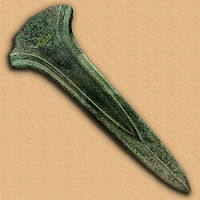
The Rock Age developed into the Statuary Age afterward the Neolithic Revolution. The Neolithic Revolution involved radical changes in agronomical technology which included development of agriculture, animal domestication, and the adoption of permanent settlements.[ citation needed ]
The Statuary Age is characterised past metal smelting of copper and its alloy statuary, an alloy of can and copper, to create implements and weapons. Polished rock tools continued to be used due to their abundance compared with the less common metals (especially tin).[ citation needed ]
This technological trend apparently began in the Fertile Crescent, and spread outward.[ commendation needed ]
Atomic number 26 Age [edit]

The Iron Age involved the adoption of fe or steel smelting technology, either by casting or forging. Iron replaced bronze,[xl] [41] and made it possible to produce tools which were stronger, lighter and cheaper to make than statuary equivalents.[42] The all-time tools and weapons were made from steel.[43]
Other societal changes oft accompanied the introduction of iron, including practice changes in art, religion and agriculture. The Iron Historic period ends with the get-go of the celebrated periods, generally marked past the development of written language that enabled cosmos of historic records.[41] [43]
The timing of the adoption of iron depended upon "the availability of iron ore and the state of knowledge".[40] [41] Iron was smelted in Egypt nigh 6000 B.C. and fe replaced bronze in the Middle East almost 1500 B.C. Chinese began casting iron nigh 5000 B.C. and their methods for casting atomic number 26 was the precursor to modern steel manufacturing methods. Most of Asia, yet, did not adopt production of iron until the historic period.[xl]
In Europe, iron was introduced about 1100 B.C. and had replaced bronze for creating weapons and tools by 500 B.C. They made iron through the forging smelting procedure and integrated casting in the Heart Ages.[40] Large loma forts or oppida were congenital either equally a refuge in time of state of war, or sometimes as permanent settlements. Agricultural practices were made more efficient with more than effective and varied iron tools.[44]
Fe was extracted from metal ore starting about 2000 B.C. in Africa.[forty]
New Globe [edit]
The New Globe periods began with the crossing of the Paleo-Indians, Athabaskan, Aleuts and Eskimos along the Bering Land Span onto the N American continent.[45]
The Paleo-Indians were the first people who entered, and later inhabited, the Americas during the final glacial episodes of the late Pleistocene period. Evidence suggests big-game hunters crossed the Bering Strait from Asia into Northward America over a land and ice bridge (Beringia), that existed between 45,000 BCE – 12,000 BCE,[46] following herds of large herbivores far into Alaska.[47]
In their book, Method and Theory in American Archaeology, Gordon Willey and Philip Phillips defined v cultural stages for the Americas, including the three prehistoric Lithic, Archaic and Formative stages. The historic stages are the Classic and Postal service-Classic stages.[48] [49]
Lithic [edit]
The Lithic period occurred from 12,000 to 6,000 years before present and included the Clovis, Folsom and Plano cultures.[49] Clovis culture was considered the first civilization to use projectile points to hunt on the North American continent. Since then, a pre-Clovis site was plant in Manis, Washington that found apply of projectile points to hunt mastodons.[50]
Archaic [edit]
The Primitive menstruum in the Americas was dated from 8,000 to ii,000 years before present.[49] People were hunters of modest game, such as deer, antelope and rabbits, and gatherers of wild plants, moving seasonally to hunting and gathering sites. Late in the Archaic menstruation, about 200-500 A.D., corn was introduced into the diet and pottery-making became an occupation for storing and curing nutrient.[51]
Determinative [edit]
The Formative phase followed the Archaic period in the Americas and continued until there was contact by European people. Some of the cultures from that menstruation include that of the Aboriginal Pueblo People, Mississippian civilization and Olmec cultures.[49]
Cultures of the Determinative Phase are supposed to possess the technologies of pottery, weaving, and adult food production. Social organization is supposed to involve permanent towns and villages, as well equally the outset ceremonial centers. Ideologically, an early priestly class or theocracy is often present or in development.[52]
Gallery [edit]
-

Fire started using a bow drill
-
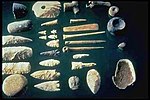
Choice of prehistoric tools
Run into also [edit]
- List of prehistoric artworks
- Timeline of human prehistory
Notes [edit]
- ^ During the Paleolithic Age, archaic humans had a lifestyle which involved express use of tools and few permanent settlements. The first major technologies, then, were tied to survival, hunting, and food training in this surround. Burn down, stone tools and weapons, and vesture were technological developments of major importance during this period. Stone Age cultures developed music, and engaged in organized warfare. A subset of Stone Age humans, including Ngaro Aborigines, developed ocean-worthy outrigger canoe technology, leading to an eastward migration across the Malay archipelago, across the Indian ocean to Republic of madagascar and too beyond the Pacific Ocean, which required noesis of the body of water currents, atmospheric condition patterns, sailing, celestial navigation, and star maps. The early Stone Age is described as Epipaleolithic or Mesolithic. The sometime is generally used to describe the early Stone Age in areas with limited glacial bear on. The later Stone Historic period, during which the rudiments of agricultural technology were developed, is called the Neolithic menstruation. During this period, polished rock tools were fabricated from a diverseness of difficult rocks such as flintstone, jade, jadeite and greenstone, largely past working exposures as quarries, merely after the valuable rocks were pursued by tunnelling underground, the first steps in mining technology. The polished axes were used for woods clearance and the establishment of ingather farming, and were so constructive every bit to remain in employ when bronze and atomic number 26 appeared.[ commendation needed ]
References [edit]
- ^ Cassells, E. Steve. (1997). The Archæology of Colorado, Revised Edition. Bedrock, Colorado: Johnson Books. pp. 6-14. ISBN 1-55566-193-ix.
- ^ "Ancient Tools Unearthed in Siberian Arctic". news.nationalgeographic.com.
- ^ a b Gabora, Liane; Russon, Anne. "The Evolution of Intelligence." affiliate in Sternberg, Robert J.; Kaufman, Scott Barry. (editors). (2011). The Cambridge Handbook of Intelligence. Cambridge University Press. p. 335. ISBN 978-0-521-51806-ii.
- ^ Leakey, Richard (1981). The Making of Mankind. Dutton Adult. pp. 65-66. ISBN 0-525-15055-2.
- ^ Wilford, John Noble. (Baronial ix, 2007). Fossils in Kenya Claiming Linear Evolution New York Times. Retrieved Dec xvi, 2011.
- ^ Dalling, Robert. (2006). The Story of U.s.a. Humans, From Atoms to Today's Civilization. Lincoln: iUniverse. ISBN 0-595-391176.
- ^ Beck, Roger B.; Black, Linda; Krieger, Larry South.; Naylor, Phillip C.; Shabaka, Dahia Ibo. (1999). Globe History: Patterns of Interaction. Evanston, IL: McDougal Littell. ISBN 0-395-87274-10.
- ^ Boehm, Christopher. (1999). Hierarchy in the forest: the development of egalitarian behavior. Cambridge: Harvard University Press. p. 198. ISBN 0-674-39031-8.
- ^ New discovery suggests Homo erectus originated from Asia Daily News & Analysis. June 8, 2011. Retrieved December 17, 2011.
- ^ Moore, Matthew. (July viii, 2010). "Norfolk earliest known settlement in northern Europe." London: The Daily Telegraph Retrieved July viii, 2010.
- ^ Ghosh, Pallab. (July 7, 2010). "Humans' early on arrival in United kingdom." BBC Retrieved July viii, 2010.
- ^ Rightmire, G. P. (1998). "Human Development in the Middle Pleistocene: The Role of Man heidelbergensis" (PDF). Evolutionary Anthropology. 6 (half-dozen): 218–227. doi:10.1002/(SICI)1520-6505(1998)6:six<218::AID-EVAN4>3.0.CO;ii-6. Archived from the original (PDF) on 2012-03-23. Retrieved 2011-12-xvi .
- ^ Burn down out of Africa: a key to the migration of prehistoric man. The Hebrew Museum of Jerusalem. October 27, 2008. Retrieved Dec 20, 2011.
- ^ The Mystery of the Pit of Basic, Atapuerca, Kingdom of spain: Species Homo heidelbergensis. Smithsonian Institution. Retrieved December 15, 2011.
- ^ Skinner, A.; Blackwell, B.; Long, R.; Seronie-Vivien, M.R.; Tillier, A.-M.; Blickstein, J. (March 28, 2007). "New ESR dates for a new bone-bearing layer at Pradayrol, Lot, French republic". Paleoanthropology Society.
- ^ Scarre, Chris. (2009). The Homo Past: World Prehistory and the Evolution of Human Societies. (2nd edition). Thames & Hudson. ISBN 0-500-28781-iii.
- ^ "Evolving in their graves: early burials hold clues to human origins - research of burying rituals of Neanderthals." Findarticles.com December fifteen, 2001. Retrieved March 25, 2011.
- ^ a b Sternberg, Robert J.; Kaufman, Scott Barry. (editors). (2011). The Cambridge Handbook of Intelligence. Cambridge University Printing. p. 335. ISBN 978-0-521-51806-2.
- ^ Lieberman, Philip. (1991). Uniquely Human. Cambridge: Harvard Academy Press. p. 162. ISBN 0-674-92183-vi.
- ^ Lieberman, Philip Uniquely Human. Cambridge: Harvard University Press. p. 163. ISBN 0-674-92183-6.
- ^ Mellars, Paul (2006). "Why did modern human populations disperse from Africa ca. lx,000 years agone? A new model". Proceedings of the National Academy of Sciences. 103 (25): 9381–9386. Bibcode:2006PNAS..103.9381M. doi:10.1073/pnas.0510792103. PMC1480416. PMID 16772383.
- ^ Mellars, Paul (2006). "Archæology and the Dispersal of Modern Humans in Europe: Deconstructing the Aurignacian". Evolutionary Anthropology. fifteen (v): 167–182. doi:10.1002/evan.20103. S2CID 85316570.
- ^ Travis, John. "The Naked Truth? Lice hint at a recent origin of clothing." Retrieved April 15, 2007.
- ^ Balter, Thou (2009). "Wearing apparel Make the (Hu) Man". Science. 325 (5946): 1329. doi:ten.1126/science.325_1329a. PMID 19745126.
- ^ Kvavadze, Due east; Bar-Yosef, O; Belfer-Cohen, A; Boaretto, Eastward; Jakeli, N; Matskevich, Z; Meshveliani, T (2009). "Supporting Online Textile 30,000-Yr-Old Wild Flax Fibers". Science. 325 (5946): 1359. Bibcode:2009Sci...325.1359K. doi:ten.1126/science.1175404. PMID 19745144. S2CID 206520793.
- ^ Travis, John. (2003)."The naked truth? Lice hint at a contempo origin of clothing." Science News. 164(viii):118.
- ^ Ian Shaw, Robert Jameson. (2002). A Dictionary of Archeology. Oxford: Blackwell Publishers. pp. 394, 396. ISBN 0-631-17423-0.
- ^ Dawn of Ancient Warfare. Ancient War machine History. Retrieved Dec 17, 2011.
- ^ Comstock, P. (1992). Ancient European Bows, The Traditional Bowyers Bible Book 2. The Lyons Press. pp. 87-88. ISBN i-58574-086-1.
- ^ Knecht, Heidi (1997). Projectile Technology. New York: Plenum Press. p. 107. ISBN0306457164.
- ^ Vermeersch, P.Thou.; Van Peer, Philip (1990). Contributions to the Mesolithic in Europe. Leuven, Belgium: Leuven University Press. p. 188. ISBN9061864089.
- ^ Cunliffe, Barry (2001). The Oxford Illustrated History of Prehistoric Europe. Oxford: Oxford University Press. pp. 79. ISBN0198143850.
- ^ a b Gupta, Anil (2010). "Origin of agriculture and domestication of plants and animals linked to early Holocene climate amelioration" (PDF). Current Science. 87: one.
- ^ a b c d Ian Shaw, Robert Jameson. (2002). A Lexicon of Archæology. Oxford: Blackwell Publishers. pp. 422-423. ISBN 0-631-17423-0.
- ^ Ian Shaw, Robert Jameson. (2002). A Dictionary of Archaeology. Oxford: Blackwell Publishers. p. 125. ISBN 0-631-17423-0.
- ^ Ian Shaw, Robert Jameson. (2002). A Dictionary of Archeology. Oxford: Blackwell Publishers. pp. 72, 390, 422-423, 466. ISBN 0-631-17423-0.
- ^ "CSA – Discovery Guides, A Brief History of Copper." Archived 2008-09-14 at the Wayback Auto CSA.com. Retrieved September 12, 2008.
- ^ Hesse, Rayner, W. (2007). Jewelrymaking through History: an Encyclopedia. Greenwood Publishing Grouping. p. 56. ISBN 0-313-33507-9.
- ^ Schmandt-Besserat, Denise. (1997). How Writing Came About. University of Texas Press. p. 102. ISBN 0-292-77704-iii.
- ^ a b c d e Barbara Ann Kipfer (2000). Encyclopedic Lexicon of Archaeology. Springer. pp. 257–258. ISBN978-0-306-46158-3 . Retrieved 16 June 2013.
- ^ a b c The Junior Encyclopædia Britannica: A reference library of general knowledge. (1897). Chicago: E.G. Melvin.
- ^ Theodore Wertime and J. D. Muhly, eds. The Coming of the Historic period of Iron (New Haven, 1980).
- ^ a b Spoerl, Joseph S. A Brief History of Iron and Steel Production. Archived 2010-06-02 at the Wayback Machine. Saint Anselm College. Retrieved December 20, 2011.
- ^ Pamela Crabtree (12 October 2000). Medieval Archaeology: An Encyclopedia. Taylor & Francis. pp. 264–265. ISBN978-0-203-80181-9 . Retrieved xvi June 2013.
- ^ Cassells, E. Steve. (1997). The Archaeology of Colorado, Revised Edition. Bedrock, Colorado: Johnson Books. p. xiii. ISBN 1-55566-193-9.
- ^ "Atlas of the Human Journey-The Genographic Project." Archived 2011-05-01 at the Wayback Machine National Geographic Society. 1996-2008.
- ^ Viegas, Jennifer. "Offset Americans Endured 20,000-Year Layover." Archived 2012-10-10 at the Wayback Machine Discovery News.
- ^ Willey, Gordon R. (1989). Glyn Edmund Daniel and Christopher Chippindale (eds.). The Pastmasters: 11 Modernistic Pioneers of Archaeology. New York: Thames & Hudson. ISBN 0-500-05051-one. OCLC 19750309.
- ^ a b c d Cassells, E. Steve. (1997). The Archeology of Colorado. (revised edition). Bedrock: Johnson Books. p. 9. ISBN 9781-55566-193-9.
- ^ Bhanoo, Sindya N. (October 20, 2011). "Large-Game Hunt Adds to Prove of Early North American Settlement." New York Times. Retrieved December 20, 2011.
- ^ Kipfer, Barbara Ann. (2000). Encyclopedic Dictionary of Archaeology. New York:Plenum Publisher. p. 341. ISBN 0-306-46158-7.
- ^ Gordon R. Willey and Philip Phillips (1957). Method and Theory in American Archaeology. University of Chicago Press. ISBN 978-0-226-89888-9.
Further reading [edit]
- Fagan, Brian; Shermer, Michael; Wrangham, Richard. (2010). Science & Humanity: From Past to the Futurity. Los Angeles Times Festival of Books.
- Karlin, C.; Julien, M. Prehistoric technology: a cognitive science? Academy of Washington.
- Klein, Richard. (2009). The Homo Career: Human being Biological and Cultural Origins, Third Edition.
- Palmer, Douglas. (1999). Atlas of the Prehistoric World. Discovery Channel Books.
- Schick, Kathy Diane. (1994). Making Silent Stones Speak: Human Development and the Dawn of Technology.
- Tudge, Colin. (1997). The Time Earlier History: 5 Million Years of Human Impact. Touchstone.
- Wescott, David. (2001). Archaic Technology:A Volume of Earth Skills.
- Wescott, David. (2001). Primitive Engineering II: Bequeathed Skill - From the Society of Primitive Technology.
- Wrangham, Richard. (2010). Catching Fire: How Cooking Made United states Human. Bones Books; First Merchandise Newspaper Edition.
- Zimmer, Carl. (2007). Smithsonian Intimate Guide to Human Origins. Harper Perennial.
External links [edit]
- Ancient human occupation of Britain
- Department of Prehistory of Europe, British Museum
- Index of Ancient Sites and Monuments, Aboriginal Wisdom
- Online Exhibits, Academy of California Museum of Paleontology
- Prehistoric Science and Technology, Aboriginal Wisdom
- Prehistoric Engineering, Ancient Arts
- Prehistoric Engineering science, Access Science
- Prehistoric Technology, Royal Alberta Museum, Canada
- Prehistory for Kids Archived 2013-07-01 at the Wayback Machine
- Evidence me: Prehistory, Interactive, educational site
- Smithsonian Institution, National Museum of Natural History
- Timeline: 2,500,000 BCE to 8,000 BCE, Jeremy Norman
- Quinson's Museum of Prehistory, French republic
Source: https://en.wikipedia.org/wiki/Prehistoric_technology
0 Response to "The Oldest Surviving Art Forms Include Carvings on Bones"
Post a Comment